
AI in Healthcare Doesn’t Scale on Anecdotes. Here’s What Does.
By Andy Fanning, CO-Founder & CEO
Health Evolution Summit (HES) is one of the few healthcare conferences that earns its reputation. It’s invitation-only and deliberately built for candor. Small sessions. No slides. The kind of frank conversation that only happens when everyone in the room knows it’s off the record. Every year, roughly 300 of the industry’s most senior payer, provider, and life sciences executives gather for three days of dialogue that doesn’t make it into press releases.
This year, AI wasn’t a track or a theme. It was the current running under every conversation, whether the session was explicitly about it or not. The question has shifted from should we invest in AI to why isn’t what we’ve already invested doing what we said it would.
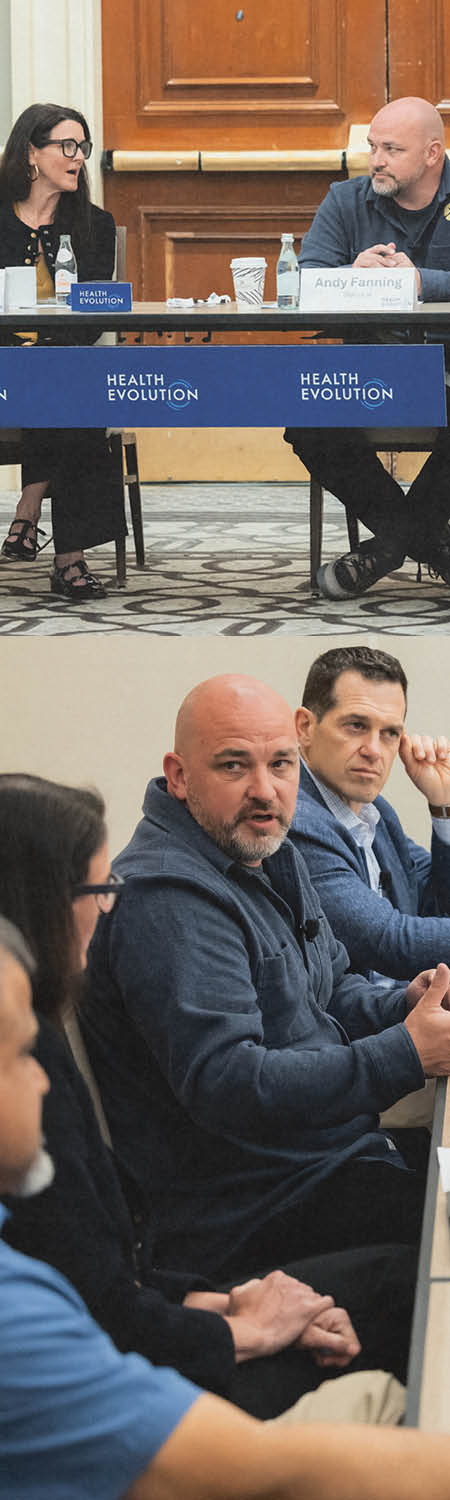
I was there for the full three days, including moderating one of the Brass Tacks sessions. Brass Tacks are small-group, off-the-record working discussions where operators get specific about what’s actually happening inside their organizations. Chatham House rules, no attribution, no press. My session was titled Turning AI Intent into Measurable Returns: Earning Trust from the Board to the Front Line. I was joined by Kelly Bliss (President, U.S. Group Health, Teladoc Health), Mangesh Patil (Chief AI Officer, HCA Healthcare), and Mike Vennera (EVP and Chief Strategy, Technology, and Operations Officer, Independence Blue Cross).
Three themes came home with me from my time in Laguna, and each connects directly to what we see at Optura every day.
The Board Has Stopped Funding the Story
Healthcare organizations talk in the language of clinical transformation, and rightfully so. But underneath that language, our organizations operate as financial institutions. Boards, markets, and owners measure on value creation, not aspiration.
At this year’s Summit, the tolerance for the anecdotal storyline around AI had run out. The era of “we think it’s working” is over. What’s replacing it is a clear expectation: connect AI deployment to a financial result a CFO can act on. The executives in these rooms aren’t anti-AI. They’re pro-accountability.
The pattern shows up across payers and providers; the business cases that survive budget cycles are the ones with the fewest variables between the investment and the outcome. Not “AI improved workflows across the enterprise” but “we cut administrative overhead for our clinicians by 30% and patient response times improved 20%”. One is a story. The other is a number. Only one of them keeps getting funded.
What makes this moment both interesting and a little uncomfortable is how few AI vendors have caught up. A consistent observation across the Summit was that most AI organizations are still pricing on activity and reporting on outputs. The partners willing to go fees-at-risk against actual outcomes are a small minority. They’re also the ones who are going to define this cycle. The rest are selling something that won’t survive the next budget review.
I keep coming back to a conversation I had with a CFO at a Blues plan. His organization had deployed AI in the call center, the back office, and IT. Vendors said it was working. His technology team said it was working. The P&L said otherwise. Every budget line was up. He couldn’t tell if any of it was actually delivering. That gap between what gets reported and what gets realized is exactly what ROAI™ was built to close.
The bottom line: Healthcare boards are done funding activity. They’re funding outcomes. If you can’t draw a straight line from your AI deployment to a number your CFO can act on, you don’t have a proof point. You have a story, and stories don’t survive the budget cycle.
AI Adoption Is a Trust Problem, Not a Technology Problem
The organizations scaling AI aren’t the ones that found the best model. They’re the ones that built trust at every level of the organization, in the right order.
It starts at the top. The CEO has to put a stake in the ground that AI is core strategy, not a project. And mean it. Not a mandate to explore but a commitment to scale. Everything downstream operates differently once that signal is clear.
But a CEO mandate is table stakes, not a deployment plan. The consistent failure mode that surfaced at HES was treating AI rollout as an IT initiative. The organizations that move past the pilot elevate it into a change-management conversation. They get business leaders owning outcomes, bring front line employees into the design process rather than just the training sessions, and invest in workforce-wide education rather than credentialing a selected few. One organization in the room put their entire workforce through mandatory AI training and gave everyone access from day one. That kind of democratization is what turns AI from something the C-suite is pushing into something the organization is pulling.
Then there’s the front line, and this is where most deployments quietly fail. Front line adoption doesn’t build gradually. It flips. There’s a threshold where adoption switches from “I won’t use this” to “when am I getting it.” Below that line, nothing moves the needle. Not training. Not mandates. Not change management. Above it, demand outpaces supply.
A health system in the room illustrated this clearly. An AI tool supporting a high-stakes clinical workflow earned almost zero voluntary adoption at an early accuracy level. After the team built a validation layer to catch what the underlying model was getting wrong, adoption swung from near zero to the majority of users, in a matter of weeks.
The crossover point is real. It’s higher than most organizations expect. And the only way through it is honest iteration.
The bottom line: AI adoption is a trust problem, not a technology problem. Build trust at the executive level, earn it through the middle with real change management, then iterate on accuracy until the front line comes along.
The Arms Race Is a Choice
More than 5% of all ChatGPT messages globally are about healthcare. A quarter of adults under 30 now turn to AI chatbots monthly for health information. The front door of healthcare doesn’t belong to healthcare anymore. It’s an LLM. The organizations that treat this as a threat are going to spend the next decade fighting for relevance. The ones that treat it as an opening, becoming the trusted layer where patients validate, contextualize, and act on what they’ve already learned, are going to move higher in the value chain.
But the more pressing conversation at HES was about what’s happening between organizations. Healthcare is in an AI arms race. Payers are building AI to manage what providers’ AI generates. Providers are building AI to navigate what payers’ AI denies. Both sides are paying for it. Outcomes aren’t improving.
The story that crystallized this in the room was around how a vendor pitched an AI solution to handle a surge of incoming calls to a payer organization. Calls that turned out to be generated by the same vendor’s product, deployed on the provider side. Bots calling bots. The right response wasn’t to buy the counter-tool. It was to call the provider, get in a room, and work through the actual underlying issues.
The collaboration thesis has real financial weight behind it. Consider the prior authorization numbers. More than 80% of prior authorization appeals are ultimately approved. Most of what gets denied first isn’t a clinical dispute. It’s a documentation gap. The ground both sides could win back together is significant. AI that resolves the uncontested cases cleanly, quickly, and at scale frees human judgment for the 20% that actually requires it. An emerging concept worth watching is “clean room” environments for multi-agent negotiation, where two organizations let AI systems work through structured dialogue with each side’s parameters transparent and observable. The infrastructure is earlier than most people realize. But the strategic question of whether we want our AI to fight or collaborate is one every executive in this industry can start answering today.
The energy closing out the Summit was something I don’t often feel at healthcare conferences: genuine conviction that this time is different. That the industry has been talking about real transformation for years, and this is the moment that talk actually gets tested. The executives who prove value, earn trust, and treat AI as the operating model are the ones who are going to define what healthcare looks like on the other side of this.
The bottom line: The arms race is a choice, not a fate. Build AI that fights and you’ll compound cost. Build AI that collaborates, that resolves the uncontested 80% and frees humans for the hard 20%, and you’ll compound value.
What I Brought Home
The boards funding the next wave of AI investment want hard numbers, not narratives. The front line teams using these tools won’t adopt them until accuracy clears a threshold that’s higher than most organizations have admitted. And the industry’s quiet AI arms race is making everyone’s financials worse, even when individual tools look like wins on paper.
This is the moment ROAI™ was built for. Prove value, and adoption follows. Earn trust, and AI can finally scale. Move beyond the pilot, and you don’t have an AI project. You have a competitive advantage.
Request a demo to talk through how Optura helps healthcare leaders measure ROAI™ and build the infrastructure for AI at scale.



Stay up to date with thoughtful takes, real outcomes, and the moves leaders are making.
Subscribe Subscribe